Gorleston Holiday Camp was the brainchild of Charles Haigh, who raised the necessary finance by bringing together a syndicate of local businessmen. The new venture occupied a 12-acre site on land that had once formed part of the Elmhurst House estate. The house itself remained standing but was not part of the camp, instead operating as a boarding house operated by Samuel Nash.
The camp was designed by architects Ernest and Geoffrey Buckingham and constructed by E. Moore & Sons, whose proprietor was one of the original members of the syndicate. From the outset, the intention was to create something rather more upmarket than the basic holiday camps then appearing around the British coast. The developers confidently declared that “the camp will be equal to the best in the country and worthy of the dignity and importance of Gorleston.” At the same time, they were keen not to make the place appear too exclusive, pledging to “do their utmost to preserve the old school tie atmosphere without being too highbrow.”
Gorleston Holiday Camp officially opened in June 1937 and was described in publicity as “The Queen Mary of Holiday Camps.” Around 300 local dignitaries attending the opening ceremony, among them were several men who were already becoming important figures in the rapidly expanding East Anglian holiday camp industry: J. Fletcher Dodd of Caister, Jack Bishop of Seacroft and Herbert Potter of Potters Resort. Their presence was particularly appropriate, as this stretch of the Norfolk coast was developing into one of the country’s most important centres for the new holiday camp movement.
Charles Haigh was appointed manager of the new camp, while his son Stan became entertainments manager. The buildings presented a suitably modern appearance, with the original colour scheme being described as “green and tango.”
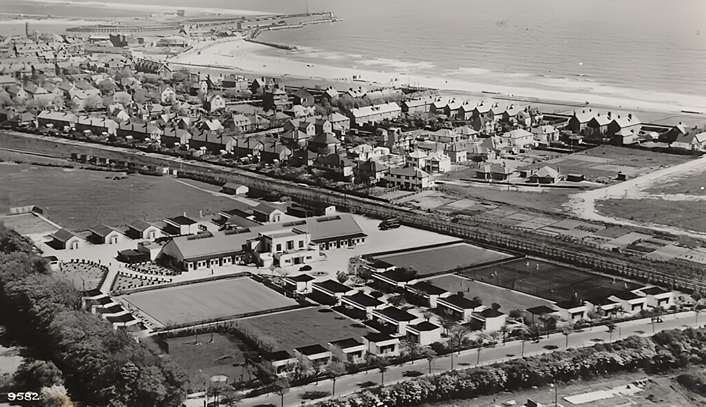
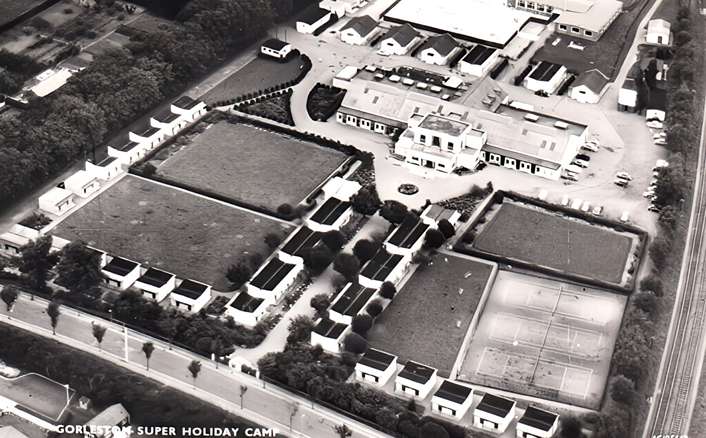
Accommodation was provided in purpose-built concrete chalets, which were considerably more substantial than the simple wooden huts found at many other holiday camps. They also offered a surprisingly good standard of comfort for 1937, with electric lighting and sinks supplied with both hot and cold running water. Toilets remained communal, however, with toilet blocks dotted around the site, while guests wanting the luxury of a bath had to pay an additional charge.
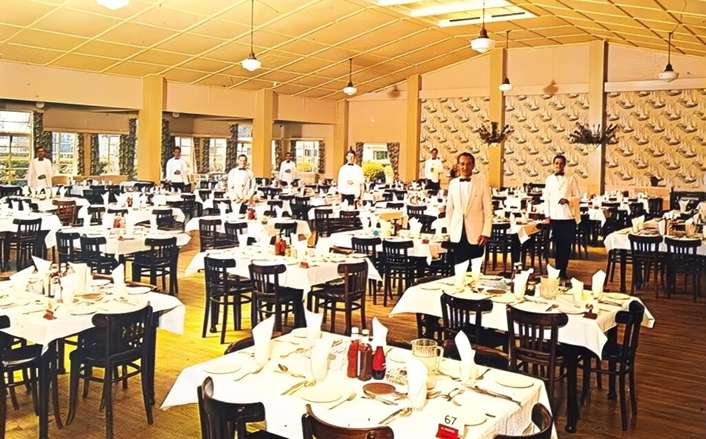
The camp could accommodate around 400 guests and operated on a full-board basis. All meals were included in the price of the holiday and were served communally in the large dining hall. As with many traditional holiday camps, this communal approach was an important part of the experience, with guests eating and socialising together rather than catering for themselves.
The Lowestoft to Great Yarmouth railway line ran directly alongside the eastern boundary of the camp, while Gorleston railway station was only a five-minute walk away. Guests could reach the station using a private footpath that ran parallel with the railway tracks, making Gorleston easily accessible at a time when the majority of holidaymakers still travelled by public transport rather than by car.
With its modern concrete chalets, full-board accommodation, convenient railway connection and aspirations towards the upper end of the holiday camp market, Gorleston opened with considerable confidence. It joined an already thriving collection of holiday camps along this part of the Norfolk coast, but its owners clearly intended it to stand apart from the competition by offering something a little more refined without becoming, as they put it, “too highbrow.”
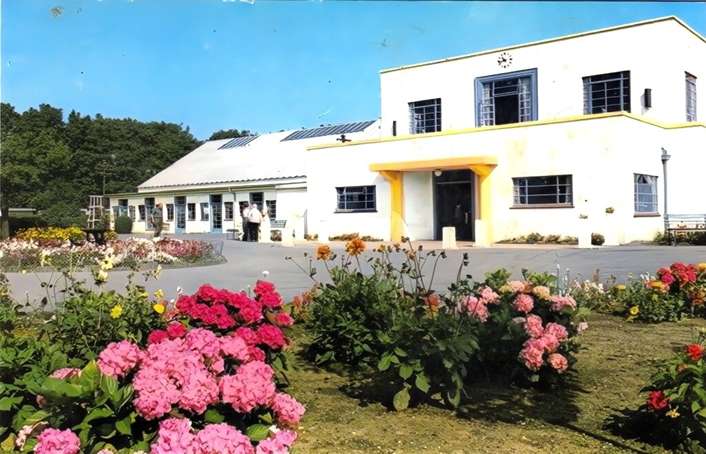
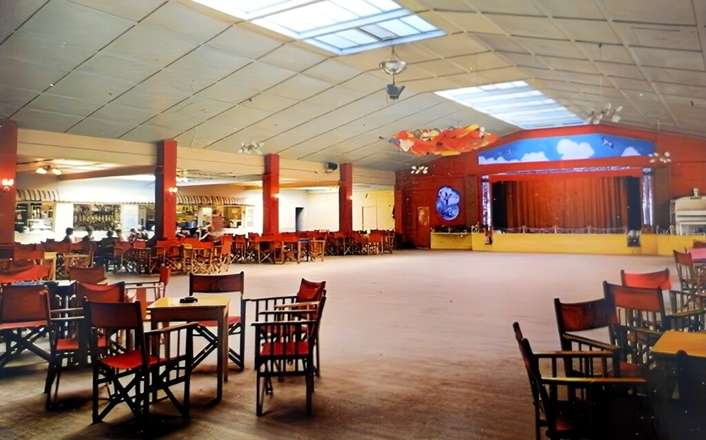
Just two years after opening, Gorleston Holiday Camp’s promising start was interrupted by the outbreak of the Second World War. The camp was requisitioned for wartime use in 1939 and would not return to its original purpose until after the conflict had ended.
After the war, the camp came under the control of Lin Thrower and in 1951 he became managing director, a position he held until the camp closed.
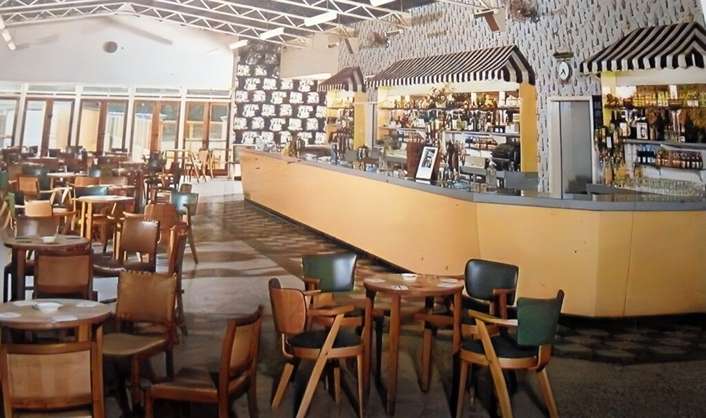
Elmhurst House was later incorporated into the holiday camp itself. The large house had originally formed the centrepiece of the estate on which the camp was built. Following its incorporation, guests who preferred more conventional hotel accommodation could choose to stay in rooms inside the house rather than in one of the chalets. The house also contained a bar, adding another social venue to the camp’s facilities.
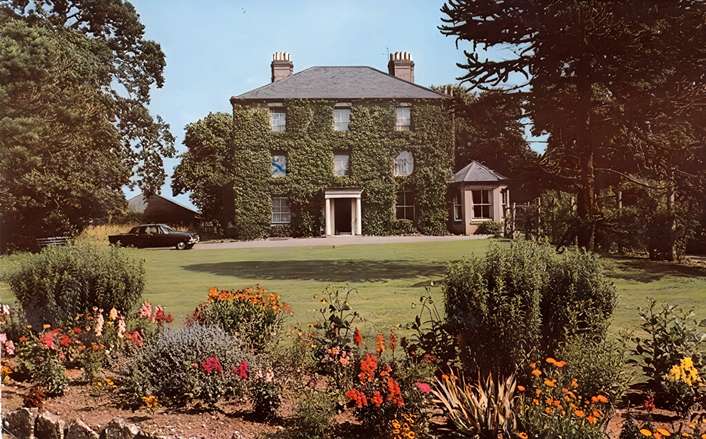
Beginning in 1953, Gorleston became particularly well known for its holidays for physically disabled people. These were normally held for two weeks towards the end of each holiday season and were offered at specially reduced rates. At a time when holidays and suitable accommodation could be much less accessible for disabled people, the scheme became an important and long-running part of Gorleston’s identity. The holidays also attracted support from entertainers appearing nearby in Great Yarmouth. Celebrities performing in the resort would often call in to meet the guests, adding something special to the fortnight. The scheme proved remarkably enduring and continued every year, in one form or another, right up until the eventual closure of the camp.
During the winter of 1954 the camp dining hall was temporarily converted into an indoor bowls centre and within four years the Gorleston Indoor Bowls League had two divisions, 27 teams and a membership of 250 people. The tradition of winter bowls continued for the next 20 years.
In 1961, a new outdoor swimming pool was constructed, providing another major attraction for guests during the summer months.
The following year, the camp narrowly escaped being involved in a tragedy. In 1962, a small aircraft operating pleasure flights from nearby Caister lost control while in the area. The aircraft narrowly missed Gorleston Holiday Camp before crashing into the garden of a house in nearby Elmhurst Close. All four people aboard the aircraft were killed.
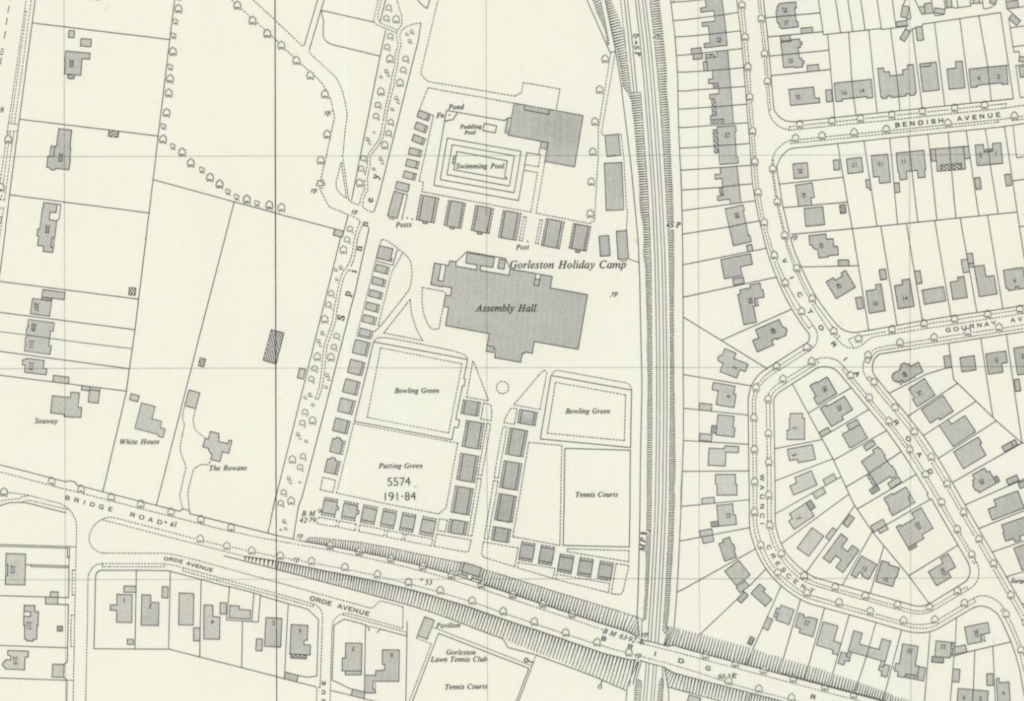
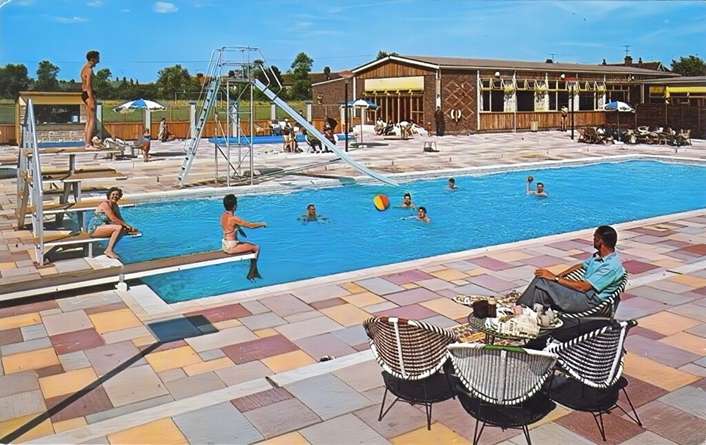
By the mid-1960s, the term “holiday camp” was beginning to sound increasingly old-fashioned. The traditional image of communal dining rooms, regimented entertainment and rows of simple chalets no longer appealed to younger generations, particularly as rising car ownership and cheaper overseas travel gave British holidaymakers a much wider choice. Across the country, operators began adopting more fashionable descriptions such as holiday villages, holiday centres and even chalet hotels in an attempt to give their properties a more modern and sophisticated image.
Gorleston followed the trend, but went considerably further. In 1968, the old Gorleston Holiday Camp name disappeared altogether and the complex was relaunched as Elmhurst Court, reviving the name of the old Elmhurst estate on which the camp had originally been built.
Another link with the camp’s early years disappeared in 1970 when the adjacent Lowestoft to Great Yarmouth railway line closed, along with Gorleston station. Its closure reflected the enormous changes in how people travelled. By this time the private car had largely replaced the railway for many families.
The camp closes
In September 1973 it was announced that the camp would be closing. The decision had come unexpectedly after the owners received an unsolicited offer for the site.
“It was never our intention to sell,” explained company chairman Mr Attree, “but then an approach was made to us right out of the blue. It was quite a shock to us at first, but it was an offer that we felt we had to give serious consideration. It has just worked from there.”
Attree clearly regretted the camp’s closure. “We will be sorry to see the end of it. I suppose it is what you call progress. Many holidaymakers are going to be very sad about it, for a lot of them have been coming here for 15 or 20 years. It is a holiday camp that has been run on the lines of a hotel and many people have voted it the best in England, certainly in the standard of its food.”
In March 1974 the entire contents of the camp were auctioned off.
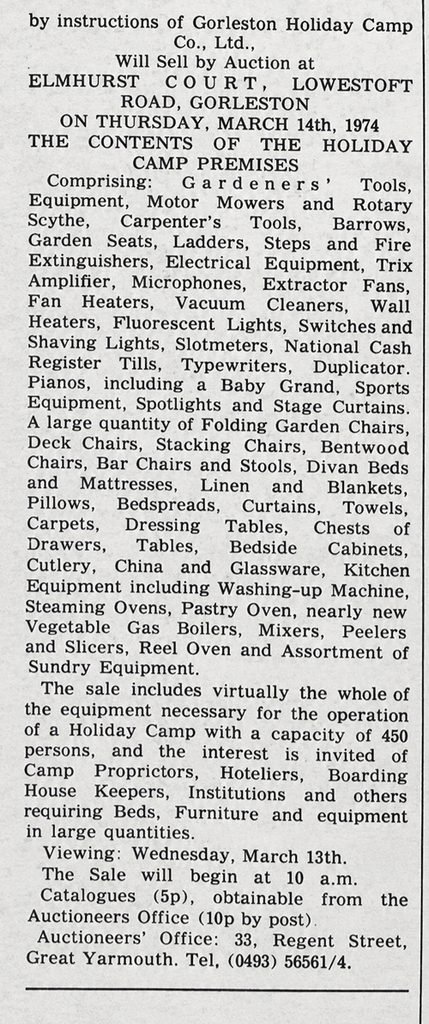
Unlike some former holiday camps, which were left to stand derelict for years, Gorleston disappeared remarkably quickly. The old buildings were cleared away and plans drawn up to redevelop the 15-acre site as a council estate with 241 homes, comprising a mixture of houses and flats.
The proposals did not go down well with local residents, who variously described the scheme as “dreary”, “unimaginative” and “appalling, of the worst 1930s kind”. The architect responsible was having none of it, accusing the critics of spreading misinformation. “My practice is not in the habit of designing such schemes and in fact have won competitions for house design and estate layouts,” he responded. “Perhaps they should refresh their memory by walking around an estate designed in the thirties.”
He did, however, point out that there were limits to what could be achieved with a publicly funded development, explaining that when “designing for the Department of the Environment one has to keep to strict standards and yardsticks if one is to obtain the necessary monies from them to carry out a housing project.”
The controversy did result in some small changes being made to the original proposals, while delays in securing government funding held the project up still further. Construction eventually began in May 1977, some three years after the holiday camp had closed.
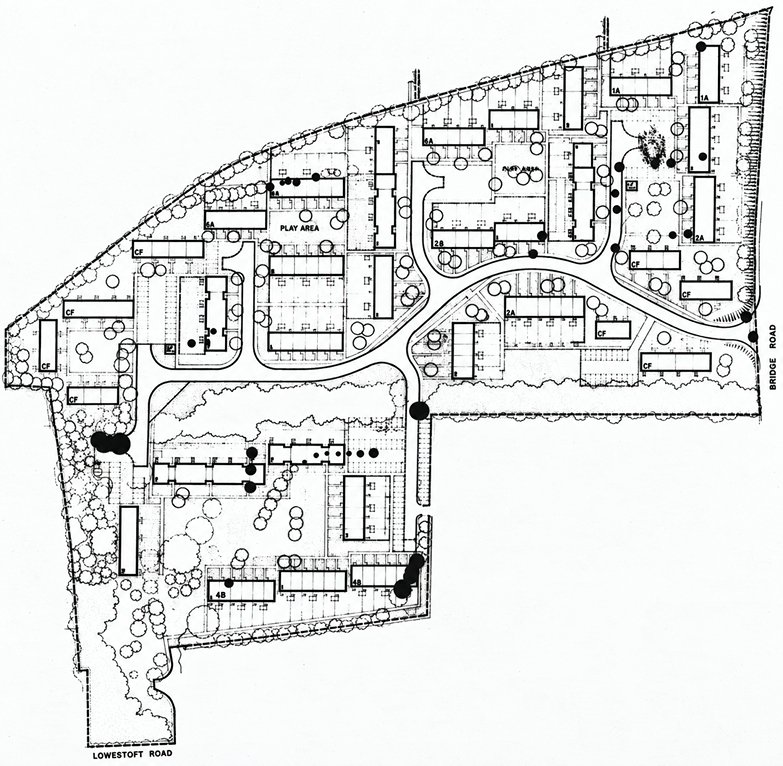
The site is now occupied by the Leman Road estate. There is one intriguing survivor from the camp. A pair of concrete stairways which once provided access from the holiday camp up to Bridge Road escaped demolition. More than half a century after the camp closed, the steps remain in place and are still used by local residents today.