Samuel Kaye and his two sons, Reginald and Philip, began not in catering but in the handbag trade. Their unexpected move into hospitality came in 1957, when they borrowed money from financier Clarence Hatry and opened a modest coffee shop at 61 Duke Street in London’s West End. The idea was simply to create a sideline business. Instead, it transformed their careers.
The Kayes quickly discovered that London’s coffee-shop market was already overcrowded, so they hit upon a different idea: an upmarket version of the traditional greasy-spoon café. The change was an immediate success, with turnover reportedly tripling almost overnight.
The first incarnation was called Egg and Bacon, but the Kayes soon refined the concept and settled on the name that would make them famous: Golden Egg.
At heart, the formula was remarkably simple. Golden Egg offered familiar, uncomplicated food such as bacon and eggs, omelettes, egg and chips, steaks, mixed grills and sandwiches, served quickly and at affordable prices. But unlike the traditional British café, customers were served at their tables in surroundings designed to make eating there feel like something of an occasion.
Bringing glamour to egg and chips
What really distinguished the early Golden Eggs was their extraordinary décor.
The Kayes were not afraid of colour or theatricality. Their West End restaurants employed bold colour schemes, unusual lighting, plastics, fibreglass and specially commissioned ceramics. Artists and ceramicists including William Newland, Margaret Hine and Nicholas Vergette were involved in creating some of the interiors.
More importantly, the restaurants were not simply identical copies of one another. Individual branches could have completely different decorative schemes and themes, giving them a character rarely associated with later restaurant chains.
The results were certainly not subtle. Philip Kaye later cheerfully admitted: “I am responsible for the vulgarity.”
That flamboyance was part of the attraction. Golden Egg occupied a curious position somewhere between a coffee bar, café and restaurant. Some branches even held licences to serve alcohol, further blurring the distinction.
The Kayes abandoned the handbag business and concentrated on expanding across London’s West End. They were firm believers in Charles Forte’s famous maxim that anyone could make a fortune in catering provided they remained within a stone’s throw of Piccadilly.
For the Kayes, it proved remarkably good advice.
Building a restaurant empire
Growth came quickly. Within only seven years the group operated sixteen Golden Egg restaurants, three Golden Plaice fish restaurants and eight Wimpy bars, generating a combined turnover of around £750,000.
A 25 per cent stake in the company was sold to investor John Bosman, and in 1964 the business launched a public share issue, with the Kaye family retaining a 40 per cent holding.
The following year the company acquired a 35 per cent interest in Angus Steak Houses. Its stake eventually increased to around 77 per cent, with Bosman taking charge of that side of the business.
The Kayes also experimented constantly with other restaurant ideas. The small Alvaro’s restaurant group was acquired, taking them into a more upmarket market, while their own concepts included the Tennessee Pancake House and an Indian restaurant called Mumbaz at 57-60 Haymarket. Mumbaz was not one of their successes. Its lease was subsequently taken over by McDonald’s, which opened a restaurant there in March 1976. It became McDonald’s fifth British outlet and its first in central London – a rather symbolic changing of the guard as the new American fast-food chains began making their presence felt.
Golden Egg goes national
The major turning point for Golden Egg came in 1965.
The Kayes entered into a joint venture with J. Lyons to take the brand beyond London through franchising. Lyons already possessed considerable experience in the field through its rapidly expanding Wimpy operation.
A separate company, Golden Egg Franchises Ltd, was established for the purpose. The original West End restaurants remained under the control of the Kaye interests, while the new organisation developed Golden Eggs elsewhere in Britain.
There was one significant difference.
The flamboyance of the London restaurants was deliberately toned down for the provinces. As the company explained:
“We do not feel that the wildly extravagant décor of the London Golden Egg restaurants would be suitably acceptable in the provinces. Therefore you could describe the décor of the new restaurants as one of restrained elegance.”
Several former Lyons teashops were subsequently converted into either Wimpy or Golden Egg restaurants, allowing the chain to establish itself rapidly in towns and cities across Britain.
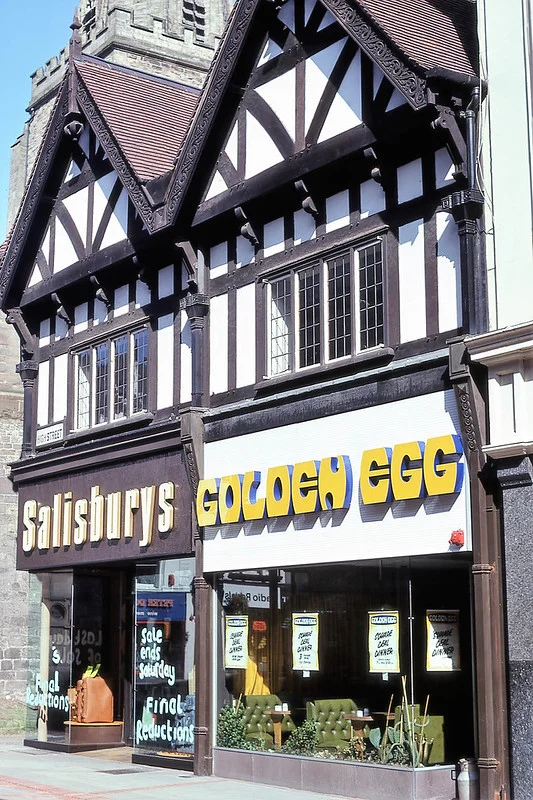
Branches appeared in places including Aberdeen, Bath, Birmingham, Bournemouth, Brighton, Colchester, Coventry, Great Yarmouth, Liverpool and Norwich, and the Golden Egg gradually became a familiar sight on British high streets and in the new shopping centres of the period.
The provincial restaurants were generally more conventional than their London counterparts, but the basic formula remained the same: inexpensive food, table service and surroundings that were just a little smarter than the traditional café.
One particularly memorable feature was the long, egg-shaped hardboard menu. For a generation of customers, Golden Egg became a dependable place for a relatively inexpensive meal while shopping or enjoying a night out.
Not everybody regarded it as sophisticated dining. The restaurants were sometimes jokingly described as “the greasy spoon to top all greasy spoons.” But that was arguably part of their appeal.
Two Golden Egg empires
The distinction between the two sides of Golden Egg is important to understanding its later history.
The Kayes continued to operate their London restaurants and wider hospitality empire, while Lyons increasingly controlled the franchised Golden Eggs elsewhere in Britain.
By 1970, Lyons had acquired full control of the Golden Egg name and the franchising operation outside London. Expansion continued and, by the middle of the decade, Golden Egg had developed into one of Britain’s most recognisable restaurant names.
Meanwhile, the Kaye family’s London interests were becoming an increasingly diverse hospitality empire.
Alongside their restaurants they accumulated around twenty pubs and several hotels, generally concentrated in those parts of central London where the combination of tourists, theatres and nightlife provided a constant stream of customers.
By 1970 the publicly quoted London business was producing annual profits of around £500,000, while its share value had tripled in six years.
The Kayes had come a very long way from selling handbags.
EMI buys the London business
The rapid rise of the business inevitably attracted the attention of larger companies.
In 1974 the publicly quoted London Golden Egg company was acquired by EMI for £10.3 million. It was one of the more unusual corporate acquisitions of the period, with the music and entertainment giant suddenly finding itself owner of a sprawling portfolio of restaurants, pubs and hotels in central London.
The deal effectively brought the Kaye family’s extraordinary period at the helm of Golden Egg to an end.
EMI retained the restaurant business for another five years. In 1979 it sold 38 restaurants to frozen-food retailer Bejam for £5 million, although the Angus Steak Houses were excluded from the deal and continued to be operated separately.
By then, however, the Golden Egg name outside London had followed a completely different corporate path.
United Biscuits takes over
In December 1976 J. Lyons sold its Pleasure Foods operation to United Biscuits. The deal included its interests in Wimpy, Golden Egg and Bake ‘n Take.
Golden Egg had therefore travelled a remarkable distance in less than twenty years: from one experimental West End coffee shop to a national restaurant chain controlled by one of Britain’s largest food companies.
But its great period of expansion was almost over.
By the late 1970s the British restaurant business was changing rapidly. McDonald’s had arrived in 1974, followed by other American-style fast-food concepts, while British consumers increasingly expected faster service and a wider range of inexpensive places to eat.
Golden Egg’s combination of waitress service, grills, omelettes, egg dishes and coffee had seemed modern in the late 1950s and early 1960s. Twenty years later it was beginning to look decidedly old-fashioned.
The restaurants themselves had changed too. The individually designed and sometimes outrageous interiors of the early London branches had largely given way to the much more standardised appearance of a conventional chain.
The disappearance of the Golden Egg
Exactly how Golden Egg disappeared from Britain’s high streets is surprisingly difficult to establish.
There does not appear to have been one dramatic nationwide closure. Instead, the chain seems to have fragmented around the end of the 1970s and beginning of the 1980s, with individual restaurants closing, being sold or reopening under different names.
This gradual disappearance probably helps explain why memories of the chain vary so widely. Some people remember their local Golden Egg disappearing around 1980, while others recall restaurants carrying the name for considerably longer.
By the 1980s, however, Golden Egg’s days as a major national restaurant chain were clearly over.
The Kayes weren’t finished
Samuel Kaye’s sons were certainly not finished with the hospitality business.
After the EMI sale, Reginald and Philip turned their attention to hotels, establishing City Hotels. True to form, the new venture expanded rapidly and was sold to Comfort Hotels in 1979 at a substantial profit.
In 1980 the brothers returned to restaurants by acquiring the Strikes hamburger chain. Rather than simply continuing the existing business, they used it as the foundation for another period of expansion.
Over the following years the company developed a network of around 55 Garfunkel’s restaurants and Deep Pan Pizza outlets — two names that themselves became familiar sights on British high streets.
In 1987 the enlarged company was sold to Belhaven, completing yet another successful cycle of acquisition, expansion and disposal.
It was an extraordinary record for a family whose involvement in catering had begun almost accidentally thirty years earlier.
What remains today?
Golden Egg has now completely vanished from Britain’s streets.
Many of the buildings have been demolished or remodelled beyond recognition, and the elaborate interiors that made the original restaurants so distinctive have largely disappeared. The original location on Duke Street is now a French Connection clothing store.
Golden Egg itself is now largely forgotten, but during the 1960s and 1970s its restaurants helped introduce millions of Britons to the idea of eating out casually and affordably.
They arrived at an interesting moment in British social history, when the old café, teashop and dining room were giving way to coffee bars, steak houses, hamburger restaurants and increasingly sophisticated national chains.
And perhaps that is Golden Egg’s real legacy. It was never haute cuisine and never pretended to be. Instead, it took something as ordinary as egg and chips, put it in colourful surroundings, added waitress service and turned it into a night out.
For a business originally intended as little more than a sideline to a handbag company, that wasn’t a bad achievement.