Cliftonville was once regarded as the posh bit of Margate – the “fashionable end of town” where the wealthier visitor came to stay. Its clifftop streets were lined with substantial hotels, elegant boarding houses and large private residences, many enjoying commanding views across the sea.
The Second World War marked a major turning point. Many of Cliftonville’s larger hotels were requisitioned by the military and other government departments, and six years of intensive wartime use inevitably took its toll. Maintenance had often been reduced to the bare minimum, and when the buildings were finally returned to their owners after the war, many were badly worn and in need of considerable investment.
Unfortunately, the market they had once served was also changing. The affluent visitors who had supported Cliftonville’s grand hotels before the war were increasingly looking elsewhere, and the resort gradually lost much of its exclusivity. Some hotel owners found themselves saddled with enormous, ageing properties that were expensive to heat, staff and maintain, but increasingly difficult to fill.
Hotels that had once commanded substantial prices were appearing on the market surprisingly cheaply. For entrepreneurs prepared to take a chance, however, these enormous buildings represented an opportunity.
Billy Butlin arrives
It was against this backdrop that Billy Butlin arrived in Cliftonville in March 1955. Spotting an opportunity in the town’s struggling hotel trade, he acquired four properties from the loss-making Nicholson Hotel Group, managed by Cyril Nicholson: the Norfolk, Florence, St George’s and Queen’s hotels. The price reflected just how far Cliftonville’s fortunes had fallen. Butlin paid a nominal £1,000 for the four hotels, while agreeing to take responsibility for their outstanding mortgages of £67,000.
Butlin immediately set about giving the hotels a much-needed refresh in preparation for the summer season. The work did not go entirely according to plan, however, as the Queen’s Hotel caught fire during the renovations and was unable to open with the others.
The remaining three hotels reopened under the Butlin’s name for the 1955 season, and the results were dramatic. Together they attracted around 9,000 guests during their first summer, approximately four times the number they had accommodated the previous year. It was a remarkable turnaround and demonstrated that Cliftonville’s problem was not necessarily a lack of demand for holidays, but that its traditional hotels needed to adapt to a very different post-war market.
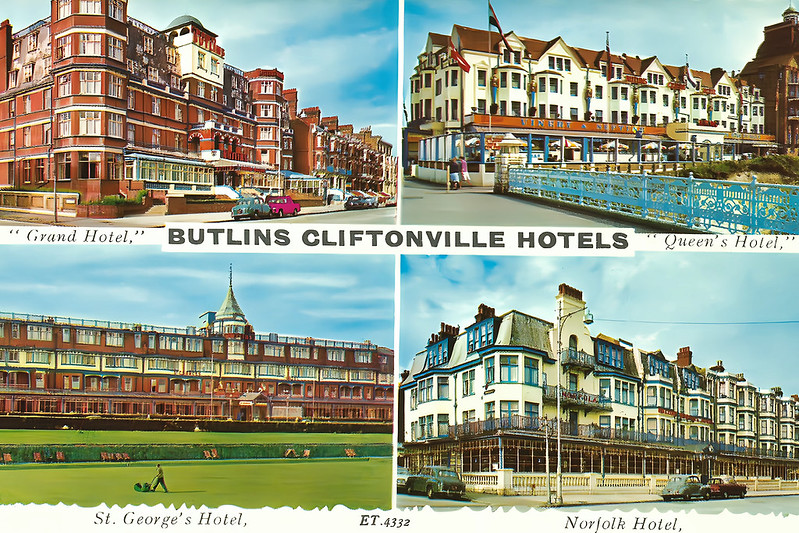
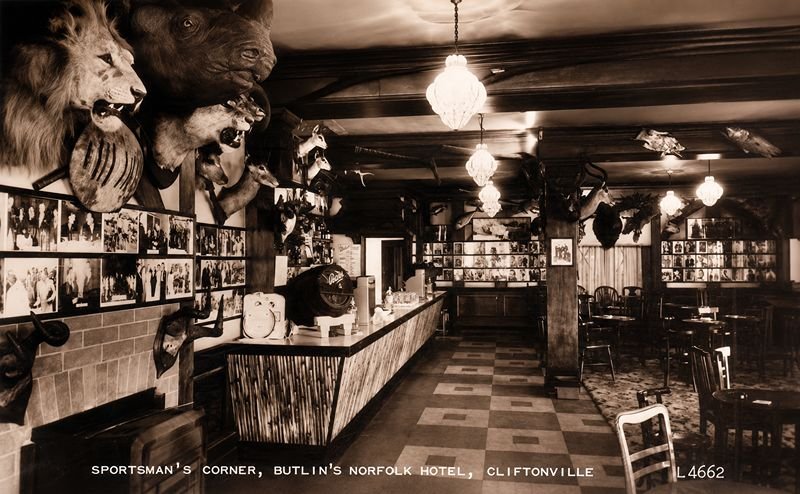
Unlike Butlin’s traditional holiday camps, which were largely seasonal, the Cliftonville hotels operated throughout the year. They were run on a full-board basis, with three meals a day included in the holiday price, and Butlin introduced many of the features already familiar to guests at his larger camps. There were Redcoats, games rooms, bars and organised evening entertainment, while the interiors were given a typically cheerful Butlin makeover, complete with “papier-mâché roses and brightly coloured cardboard parrots.”
Guests were allocated to a particular hotel when they booked, but were free to move between the different Butlin hotels and make use of the facilities and entertainment provided at the others. During the busy summer season as many as 80 Redcoats would be resident in the town.
Encouraged by the success of his original properties, Butlin continued expanding his presence in Cliftonville throughout the remainder of the 1950s, eventually purchasing another five hotels. Not all became holiday hotels: some were used primarily to accommodate the growing number of staff required to run the operation, while others were acquired and resold relatively quickly.
His impact on Cliftonville extended well beyond the hotels themselves. Thousands of additional holidaymakers were now being drawn into the town, providing valuable business for local shops, cafés, pubs and attractions. Butlin was widely credited with helping to revitalise the resort, and became something of a local hero. Several councillors even urged him to stand for Mayor. Butlin, however, had little enthusiasm for entering politics and declined the suggestion.
By the mid-1970s only 4 hotels were left and these remained under Butlins ownership until being sold in July 1999.
List of Butlins Hotels in Cliftonville
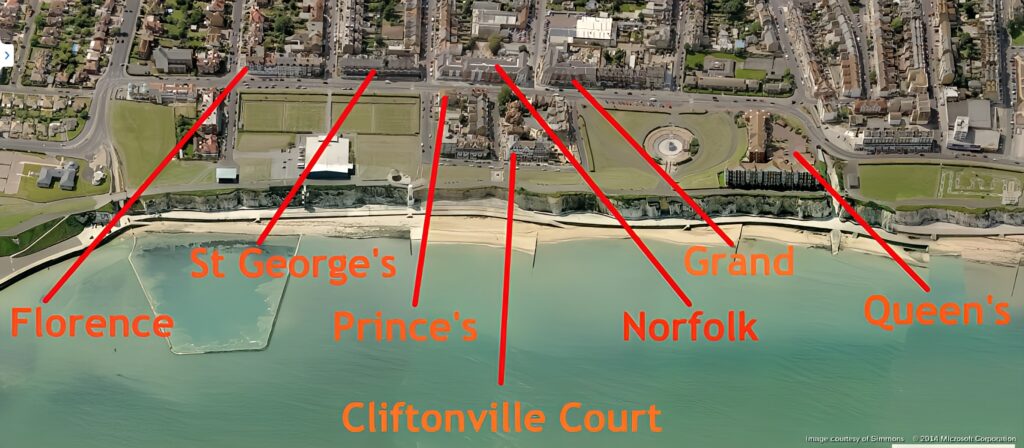
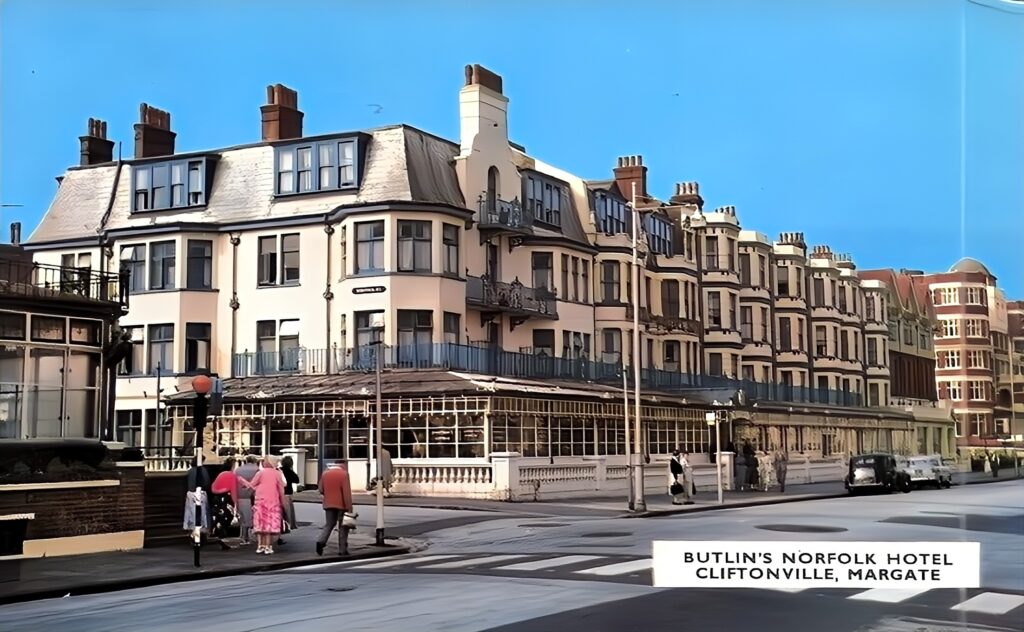
Norfolk Hotel, 200 bedrooms, acquired from Nicholson Hotels, owned by Butlins from 1955 to 1999, sold to the Grand Hotel Group, demolished 2005
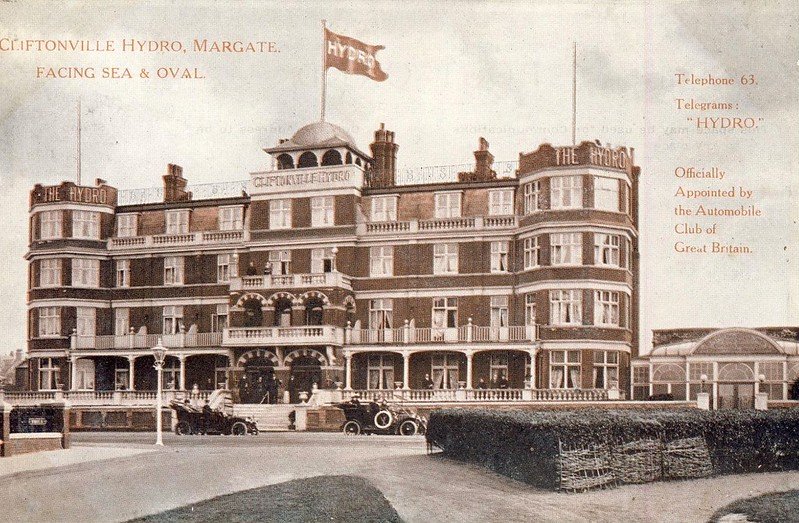
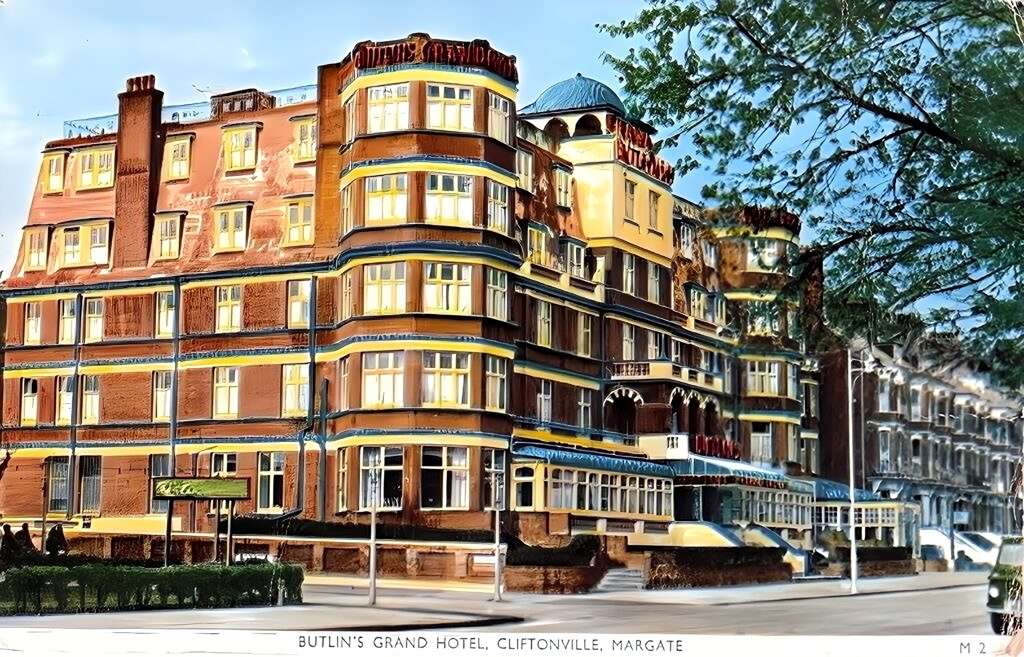
Grand Hotel opened 1904 by Thomas Higgins as the Cliftonville Hydro Hotel. Had 110 bedrooms and was renamed the Grand in 1920. After the war it was acquired by boxer Benny Lee and sold to Buitlins in 1956. Owned by Butlins until 1999 then sold to the Grand Hotels Group, demolished 2005
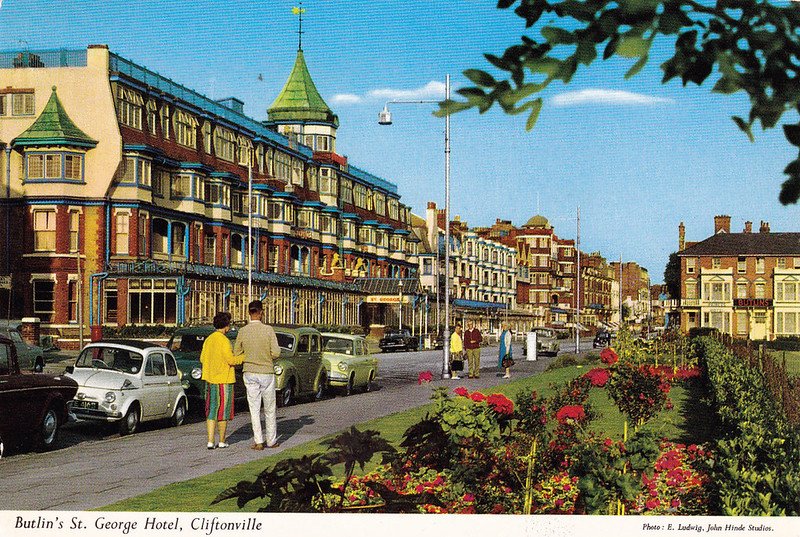
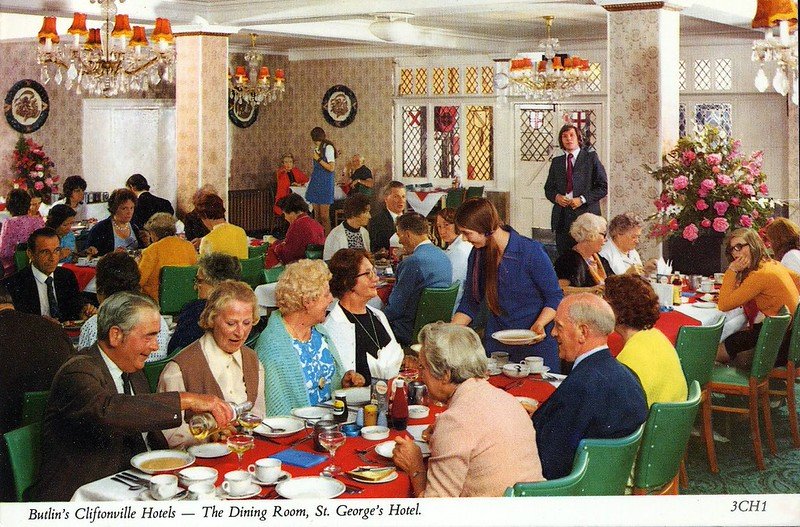
St George’s Hotel, 280 bedrooms, acquired from Nicholson Hotels, owned by Butlins from 1955 to 1999, sold to the Grand Hotel Group, demolished 2007
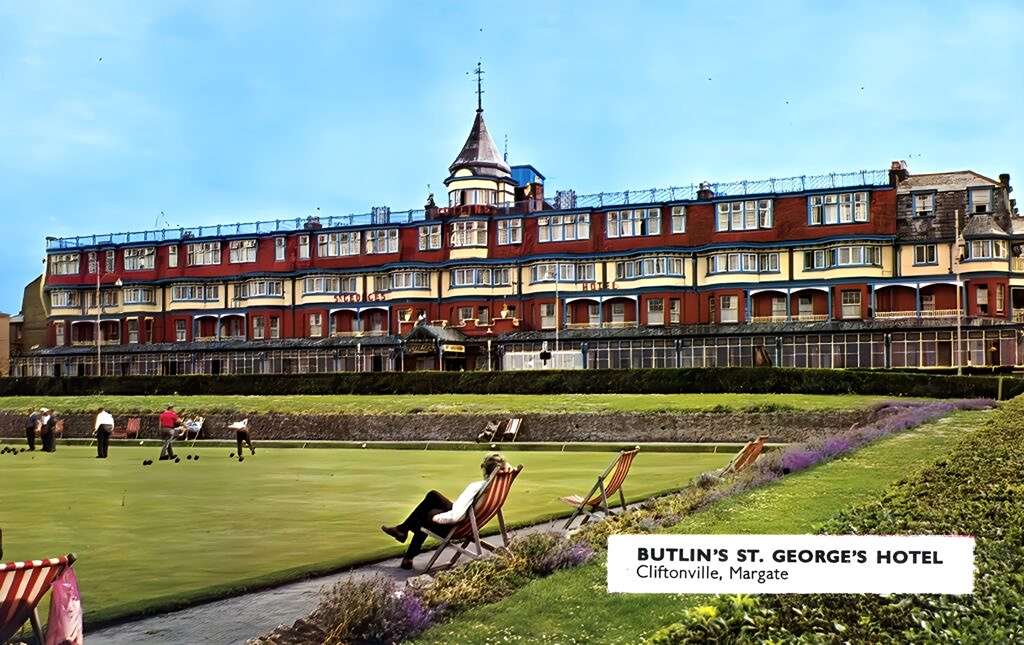
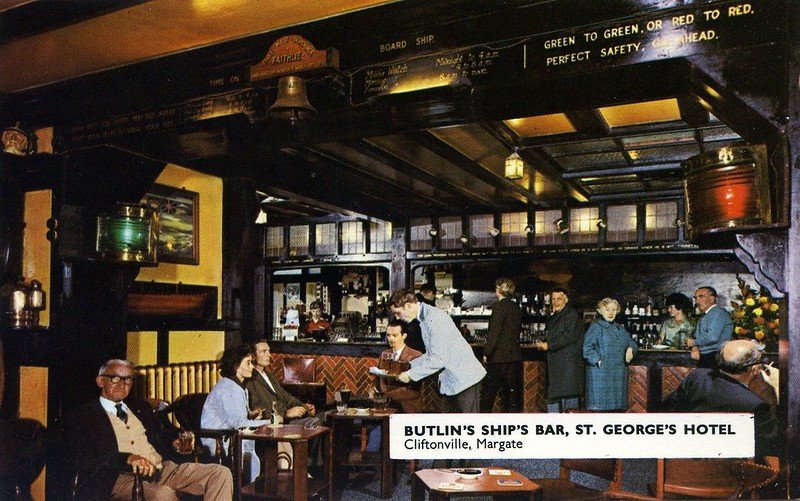
The Norfolk, Grand and St George’s were next door to each other and around 1990 they were connected by a 600ft underground tunnel which was the brainchild of hotels boss David Shelley. By this time they were being marketed under one name – the Butlins Cliftonville Hotels. The standard full board option was latrer dropped in favour of half-board (breakfast and dinner only). The main dining room was located in the St George’s, so residents of the other two hotels could face a lengthy walk for meals.
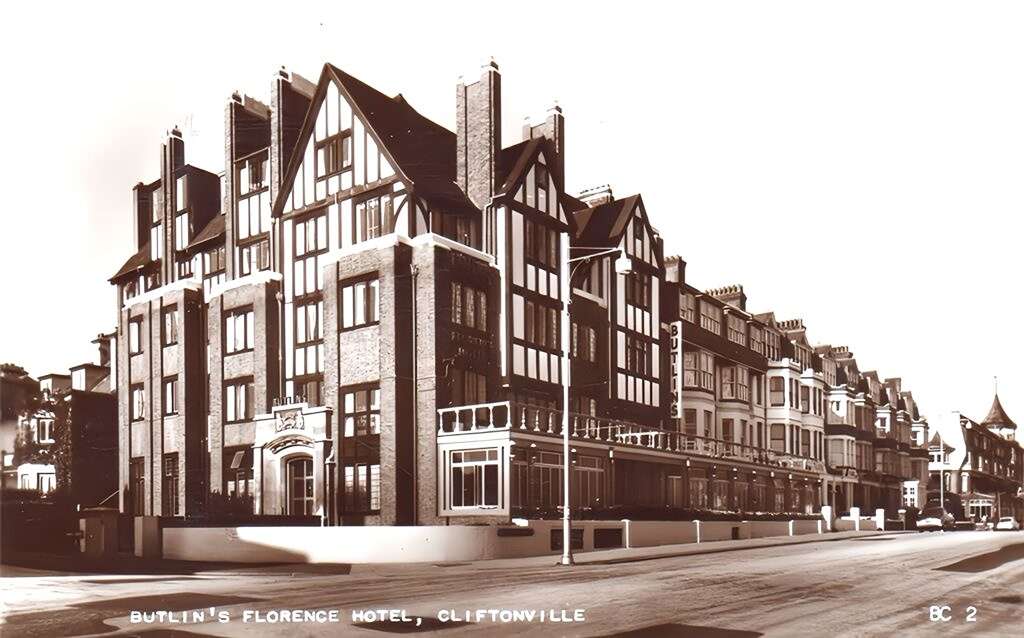
Florence Hotel came as part of the Nicholson Hotel acquisition in 1955. Had 80 bedrooms and was mostly used as staff accommodation. Sold in November 1971 to Paul Singh and later converted into 31 self-contained flats known as Florence Court. Still standing today.
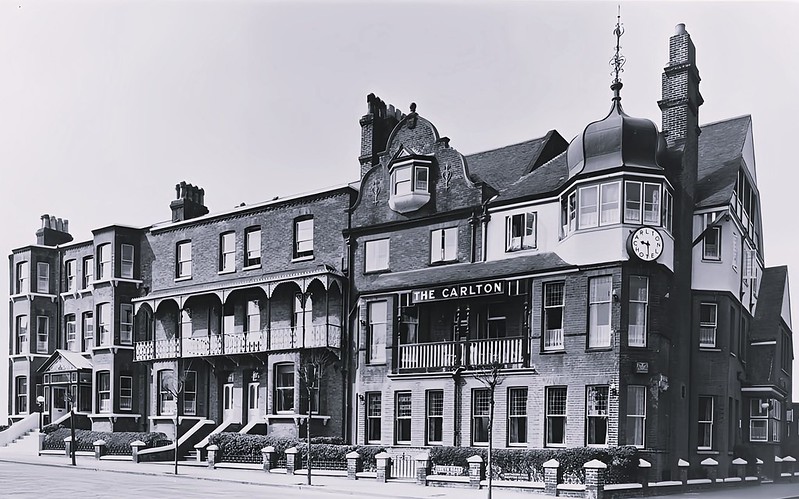
Carlton Hotel, 54 bedrooms, acquired 1959, later known as the Queen’s Carlton Hotel. Originally intended for young couples with babies and featuring “trained staff and qualified nurses”. Sold in November 1968 to the Inner London Education Authority. Converted into residential flats in the 1970s. Still standing today, now known as Carlton Mansions.
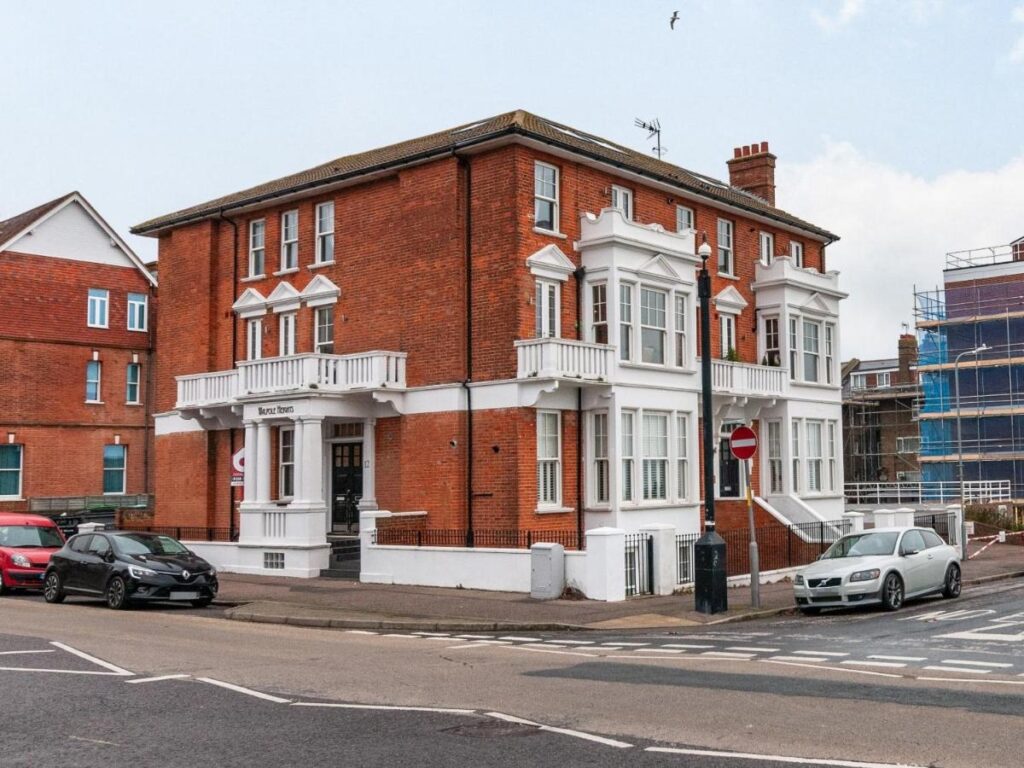
Prince’s Hotel. Acquired from the Gradus family in 1956. Only ever used for staff accommodation and offices. In 1993 an armed robber made off with £40,000 in wage packets for the staff. It was sold in 2004 and converted into 9 luxury flats and renamed Walpole Heights. Still standing today
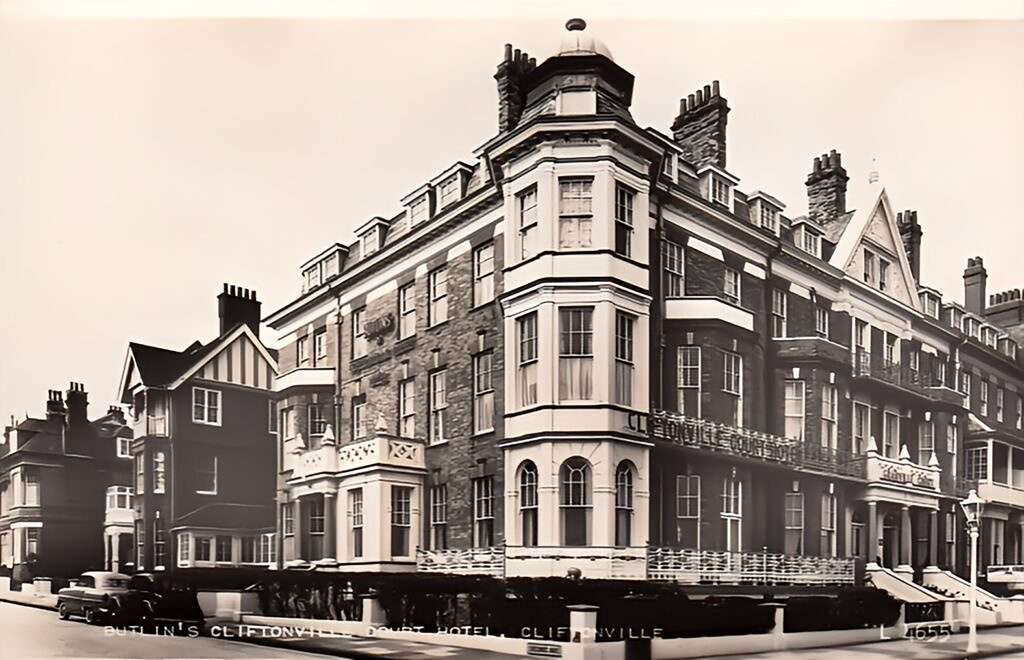
Cliftonville Court Hotel – Owned by Edwin Carloss this 40-bedroom hotel went bankrupt in 1956 and was sold to Butlins later that year. It was resold in the early-1960s and converted into flats in 1965. Still standing today as Cliftonville Court.
Hurlingham Hotel – I can’t seem to find much information on this one. It was located on Surrey Road.
The Queen’s Hotel
The Queen’s had a much more interesting history and deserves to be covered in more detail:
The hotel was originally several smaller hotels which were joined together in 1910. A new facade was built along the front making it appear like one big hotel although the view from the rear still showed a hodgepodge of different buildings. It was known for many years as The Queen’s Highcliffe Hotel. Requisitioned during the war it had remained closed ever since and was in a rundown condition. It was acquired as part of the Nicholson Hotels purchase in 1955.
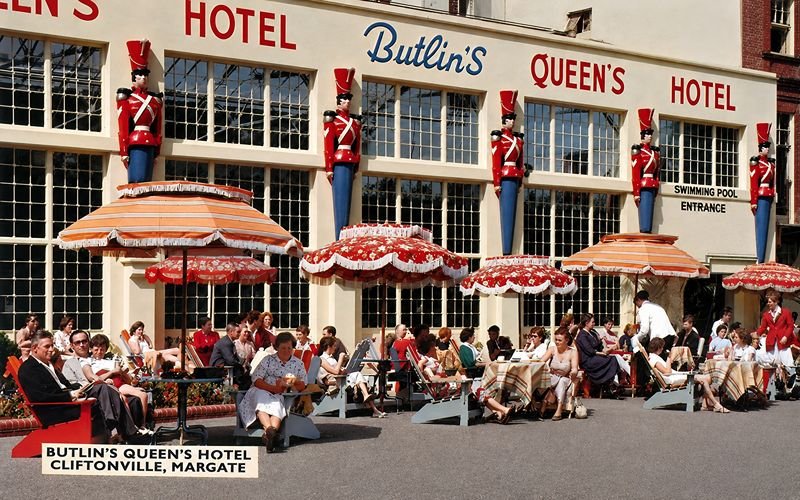
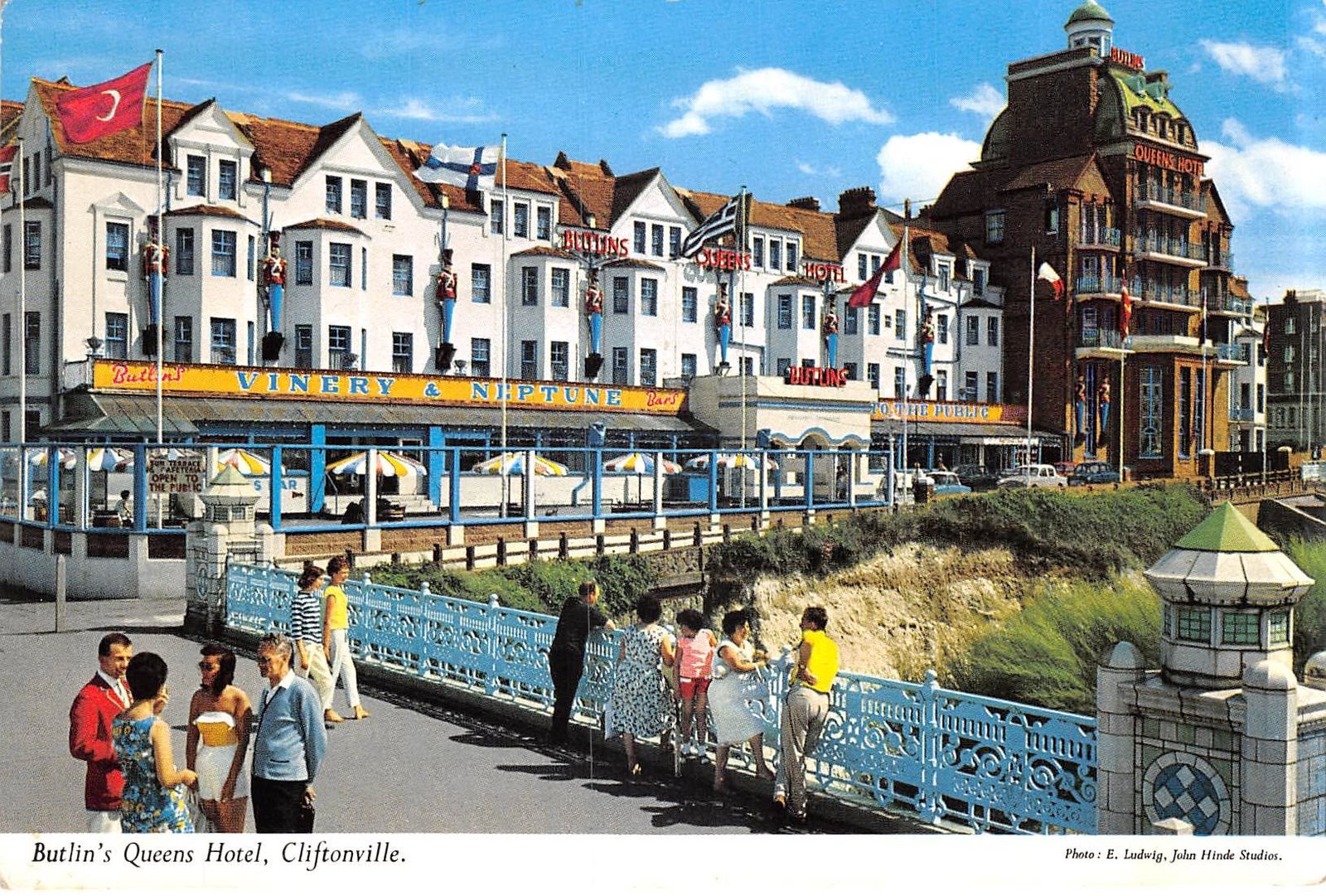
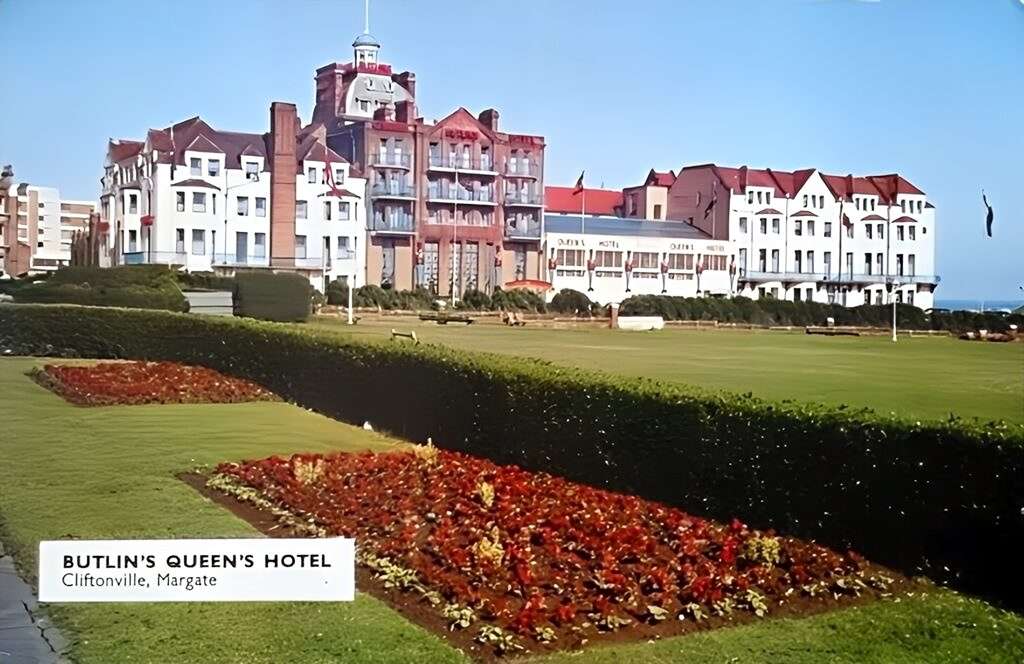
It was undergoing an extensive rebuild and was due to be officially opened on 16th May 1955. But a huge fire 3 days beforehand destroyed the middle third of the building including the ballroom, Tudor dining hall and several guest rooms. Commenting on the fire Butlin said “we were rather unlucky with the fire but not so unlucky as the insurance company”
Over the next year the hotel was rebuilt and a new indoor swimming pool was constructed in the fire damaged section. The pool featured underwater viewing windows, an idea that also appeared at Butlins Ayr that year. This feature later became a common sight at most Butlins camps.
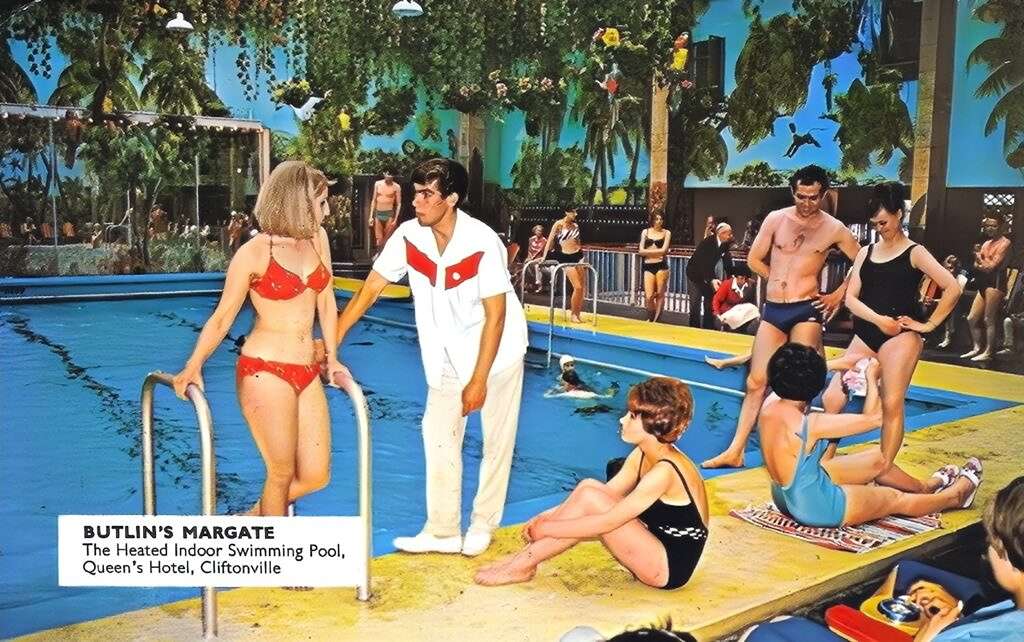
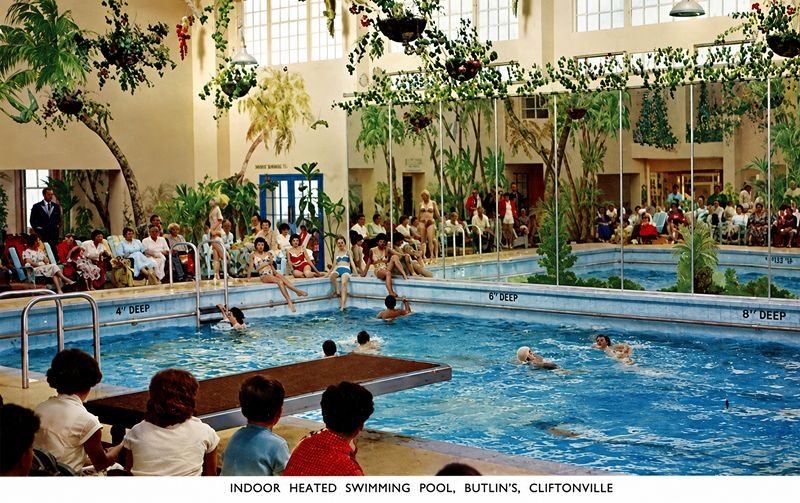
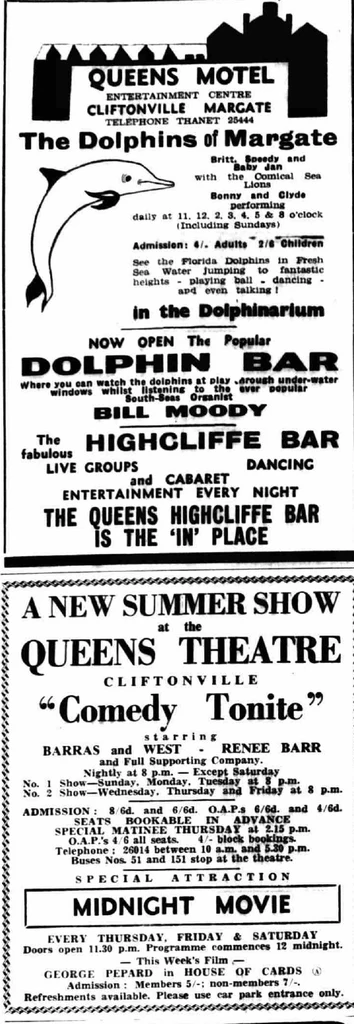
Despite Butlin’s wider success in Cliftonville, the Queen’s was never one of its more successful hotels. In November 1968 it was sold to Hoser’s Tea Gardens, operated by Harold Hoser and Sam Ridler. The new owners abandoned the traditional full-board format in favour of bed and breakfast and renamed the property the Queen’s Motel Entertainment Centre. Rather than operating everything themselves, various parts of the sprawling complex were leased to third-party operators, with an increasing emphasis placed on entertainment rather than simply providing holiday accommodation.
At around the same time, Scarborough businessman Don Robinson announced an ambitious plan for the neighbouring Cliftonville Oval. He proposed converting it into a “Marineland”, where dolphins and sea lions would perform in a large purpose-built pool beneath an enormous umbrella-style roof. The scheme would have created a substantial new tourist attraction for Cliftonville, but the plans were eventually abandoned.
Instead, a considerably cheaper alternative was developed inside the Queen’s itself. In April 1969, the hotel’s existing indoor swimming pool was filled with seawater and converted into a small dolphinarium. Two dolphins, Britt and Turk, became its star attractions, performing as many as eight shows each day.
Elsewhere in the complex, the theatre offered a Waltzing Waters show during the daytime, featuring illuminated fountains choreographed to music, while the evenings were given over to an Old Time Music Hall. Even the bars were given a more flamboyant image, with Bunny Girls introduced to serve customers. The Queen’s was effectively becoming as much an entertainment centre and visitor attraction as it was a hotel.
Another change of ownership followed in March 1970, when the Queen’s was acquired by Louis Holloway, owner of the nearby Fort Lodge Hotel. Holloway retained the dolphin attraction, with Britt and Turk returning for another season, now joined by two sea lions named Sonny and Clyde. The entertainment programme was refreshed once again, including the introduction of a new comedy show in the theatre.
Later that year a model village was constructed outside on the site of the old skating rink. It was built in conjunction with Woburn Abbey and the official opening was performed by the Duke and Duchess of Bedford.
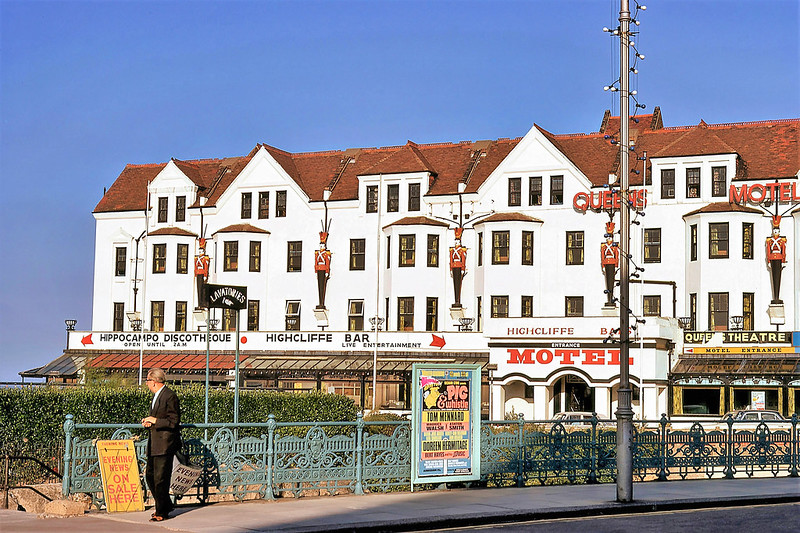
By the early 1970s, the future of the Queen’s was becoming increasingly uncertain. In March 1974, plans were submitted to demolish the hotel and replace it with an 11-storey apartment block. The proposal immediately attracted opposition, with one local councillor describing the planned tower as a “monumental eyesore.” Planning permission was refused, leaving the ageing hotel with no obvious long-term future.
The Queen’s finally closed as a hotel at the end of 1974, although this did not mean the entire complex shut down. Several of its entertainment facilities continued operating independently, including the dolphin show and two nightclubs, Hippocampo and Bellamy’s.
The nightclubs encountered an unusual problem in 1976 following the introduction of new sex equality legislation. Their previous policy of admitting women free of charge could no longer continue, something the management feared would upset the delicate balance of the nightclub trade. As one spokesman complained: “With girls having to pay the full whack, their numbers are bound to decline – who wants to go to a club full of blokes?”
Meanwhile, attempts were being made to find new uses for parts of the sprawling complex. An indoor model railway opened in 1976, centred around a large HO-scale German layout, while an alcohol-free disco was introduced for the under-18s. That same year the model village and dolphin show closed down, removing two of its principal daytime attractions.
As more of the property fell out of use, its increasingly shabby condition became a source of frustration locally. In 1977, an enforcement notice was served on the owners requiring them to clean up what had by then become an eyesore.
Redevelopment remained equally contentious. After the rejection of the original 11-storey tower, revised proposals were submitted for seven eight-storey apartment blocks. These too were rejected. Another scheme followed, this time consisting of eight six-storey blocks, but this did little to satisfy councillors.
With agreement over redevelopment seemingly impossible, the remains of the Queen’s continued to deteriorate. The hotel itself was finally demolished in March 1979, but demolition did little to improve matters. Instead of being promptly redeveloped, the site was left strewn with rubble and gradually became overgrown with weeds. What had once been one of Cliftonville’s substantial seaside hotels was now little more than a derelict wasteland.
The land was subsequently put up for sale, beginning another lengthy period of proposals, objections and planning battles. The 1980s came and went without anything being built, and the site became symbolic of Cliftonville’s wider difficulties.
It was not until 1991, some seventeen years after the hotel had closed and twelve years after its demolition, that a scheme was finally approved. After all the arguments over high-rise towers and large apartment complexes, the eventual development was considerably more modest: two three-storey blocks, each containing around 60 flats. It brought to an end a remarkably protracted redevelopment saga and finally erased one of the most conspicuous reminders of Cliftonville’s post-war decline.
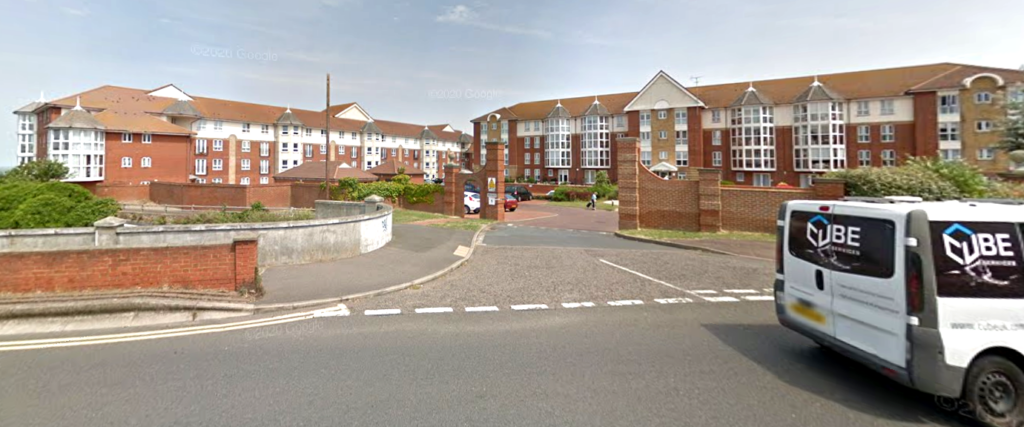
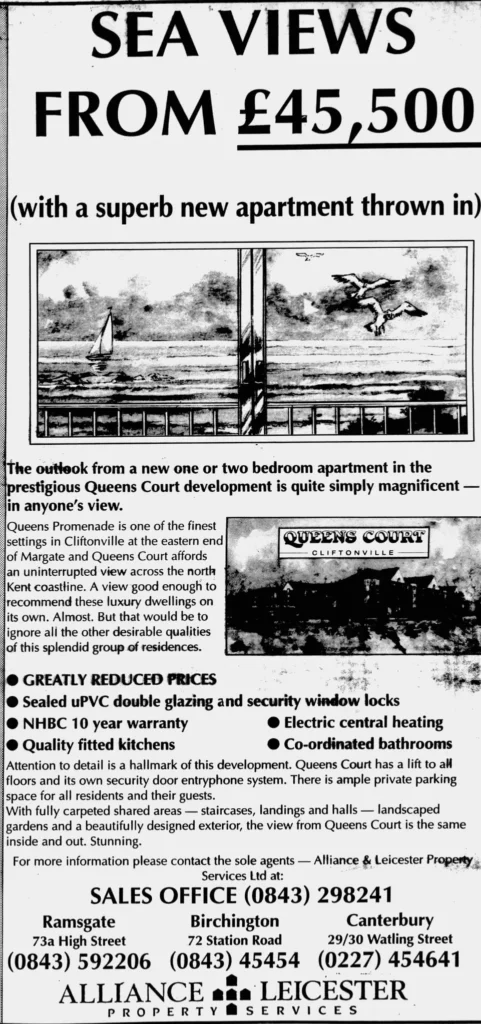
Construction of the new development was finally completed by June 1992, seemingly bringing an end to nearly two decades of uncertainty surrounding the former Queen’s Hotel site. Yet even then, the troubled history of the property was not quite over. Shortly after completing the scheme, the developers collapsed into bankruptcy with debts of around £1.3 million.
The failure left a number of local contractors and suppliers substantially out of pocket. Tradesmen who had worked on the development picketed the site, demanding payment for goods and services they had supplied but for which they had not been paid.
With the development in financial difficulty, the Alliance & Leicester Building Society, which had financed its construction, took control of the project. In an attempt to recover some of the money invested, one of the two apartment blocks was subsequently sold to a housing association.
The decision caused considerable dismay among some local residents, who had expected the redevelopment of the long-derelict Queen’s site to help improve the image and fortunes of this part of Cliftonville. After years of arguments over high-rise towers, abandoned redevelopment schemes, demolition and dereliction, even the eventual replacement of the Queen’s had become embroiled in controversy.